Head to head
MacBook Air M4 vs MacBook Air M3: is the upgrade worth it
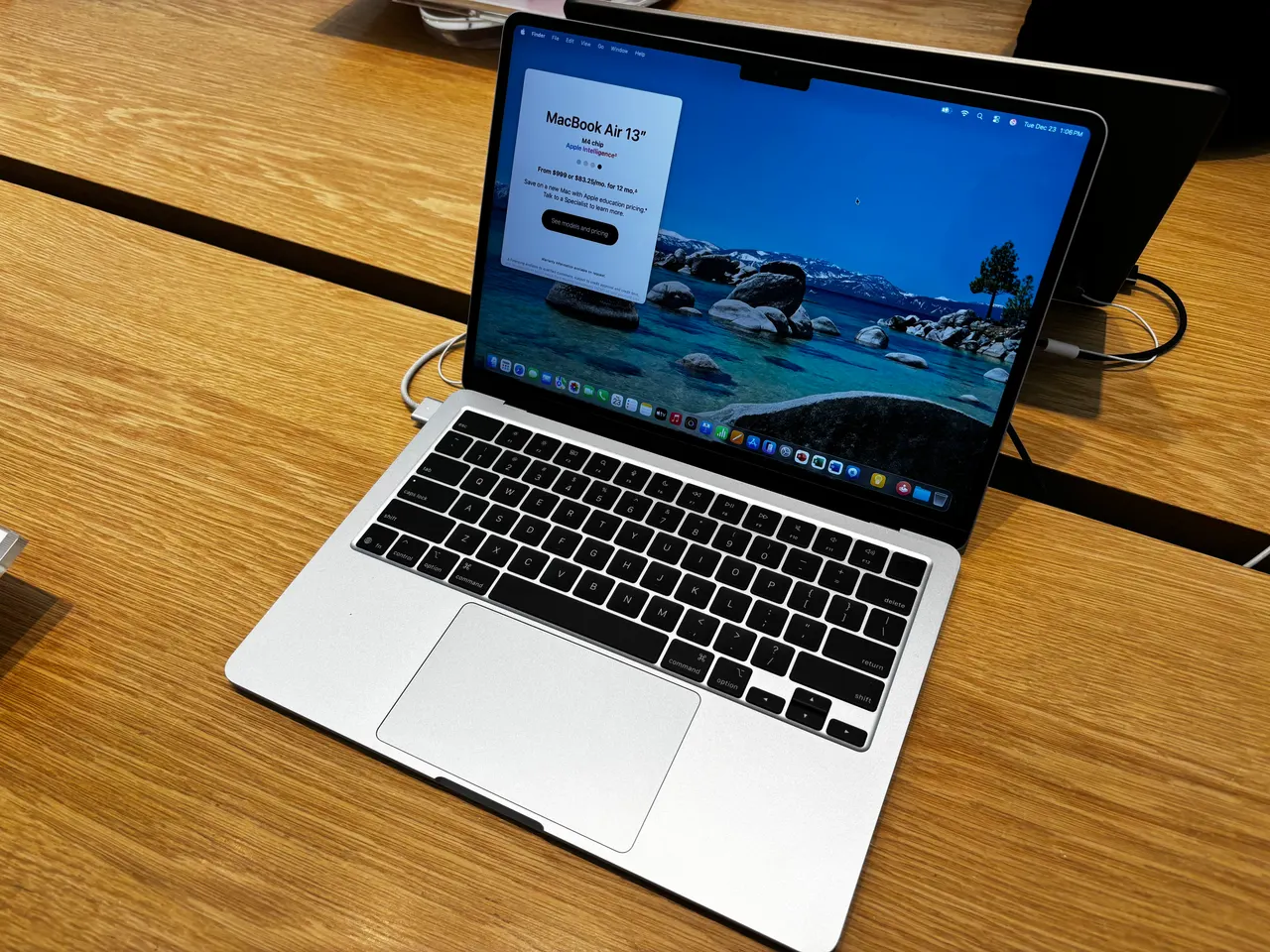
This is a pure upgrade-decision search. People owning or eyeing an M3 Air want to know if the M4 is worth it, or whether a discounted M3 is the smarter buy. The answer is mostly about the 8 GB versus 16 GB base and the 100-dollar price cut, not raw CPU.
Some links are affiliate links; we may earn a commission at no extra cost to you. How we make money.
Specs at a glance
| Spec | Apple MacBook Air 13 (M4) | Apple MacBook Air 13 (M3) |
|---|---|---|
| Price | ~999 USD (best in row) | ~1099 USD +$100 |
| Released | 2025 (best in row) | 2024 |
| CPU | Apple M4 (10-core) | Apple M3 (8-core) |
| GPU | Apple M4 8-core GPU | Apple M3 GPU (10-core) |
| RAM | 16 GB (soldered) (best in row) | 8 GB (soldered) −8 GB |
| Storage | 256 GB | 256 GB |
| Screen | 13.6" 2560x1664 @ 60Hz | 13.6" 2560x1664 @ 60Hz |
| Weight | 1.24 kg | 1.24 kg |
| Battery (real) | ~15 h (best in row) | ~14 h −1 h |
| Linux | problematic | problematic |
The verdict
Buy the M4 Air, and do not overthink it. The M4 itself is a modest step over the M3 for everyday use; nobody browsing or writing will feel the chip difference. What matters is that Apple killed the 8 GB base and made 16 GB standard on the M4 Air while cutting the price to 999 USD, where the M3 Air launched at 1099 USD with 8 GB. An 8 GB Apple Silicon machine in 2025 is a compromise you will feel in a few years of browser tabs and app bloat; 16 GB for less money is the easy call. Only buy the M3 Air if you find one heavily discounted with 16 GB and the saving is large, or if you already own one, in which case there is no reason to upgrade. For a new purchase, the M4 Air is both cheaper and better specced.
Prices in the table are indicative RRP, not live. Some links are affiliate links; we may earn a commission at no extra cost to you. How we make money.
The chip is the least important part
The M4 is a real generational step over the M3 in benchmarks, but for the things a MacBook Air is bought for, browsing, writing, email, light photo edits, video calls, the difference is small enough that you will not notice it in daily use. Both are fanless, both stay silent, both are quick. If someone tells you to upgrade an M3 Air to an M4 Air for the speed, ignore them: that is not where the value is. The M4 does pull ahead on sustained multi-core and GPU and media work, so if you push the machine harder than a typical Air user, the chip matters more. For the typical buyer, treat the CPU difference as a tie-breaker, not a reason.
Where the real difference lives: RAM and price
Here is the decision. The M3 Air's compared config is 8 GB of soldered RAM; the M4 Air's is 16 GB soldered. RAM is not upgradeable on either, ever, so whatever you buy is what you keep for the life of the machine. An 8 GB Apple Silicon laptop works fine today and works less fine every year as browsers, Electron apps, and the OS itself grow. Buying 8 GB in 2025 is buying a shorter useful life. Now stack the price on top: the M4 Air lists 999 USD (1199 EUR); the M3 Air lists 1099 USD (1299 EUR). The newer machine with double the base RAM is the cheaper machine. That is the whole argument. There is almost no scenario where paying more for an 8 GB M3 over a 16 GB M4 makes sense at list price.
Battery, build, and the rest
Everything else is close enough not to swing the decision. The M3 Air gets about 14 real hours; the M4 Air about 15. Both are roughly 1.24 kg with the same 13.6-inch 2560x1664 60 Hz panel at 500 nits and the same 9-out-of-10 build. Keyboards are the same well-regarded scissor units. Storage starts at 256 GB on both compared configs, and SSD is also non-upgradeable, so size that at purchase like the RAM. There is no design or screen reason to prefer one over the other; they are the same laptop a year apart. The only meaningful hardware differences are the chip, which barely matters for typical use, and the base RAM, which matters a lot, and the RAM difference points at the M4.
Linux note and the recommendation
Neither Air is a Linux machine, and the M4 is slightly worse for it. Linux on Apple Silicon means Asahi Linux, which targets the M1 and M2 families; the M3 is still in development and the M4 is the least developed target with only a minimal boot reported. The M3 scores 3 on Linux and the M4 scores 1, but in practice both mean the same thing for a buyer: do not buy either expecting to dual-boot Linux. If Linux is your goal, neither belongs on your list. For the macOS buyer, which is everyone realistically cross-shopping these two, the recommendation is simple: buy the M4 Air. It is newer, has double the base RAM, and costs less than the M3 Air at list. The only reason to choose an M3 Air is a steep discount on a 16 GB unit, or already owning one, where upgrading buys you nothing worth the money.
FAQ
Is the M4 Air noticeably faster than the M3 Air?
In benchmarks yes, in daily use mostly no. For browsing, writing, email, and light edits you will not feel the difference. The M4 pulls ahead in sustained multi-core, GPU, and media work, so it matters only if you push the Air harder than a typical user.
Why is the M4 Air cheaper than the M3 Air was?
Apple cut the Air's starting price to 999 USD with the M4 and made 16 GB RAM standard, where the M3 Air launched at 1099 USD with an 8 GB base. The newer machine is both cheaper at list and better specced, which is why it is the default recommendation.
Does 8 GB versus 16 GB really matter on a MacBook Air?
Yes, over the life of the machine. RAM is soldered and never upgradeable. 8 GB works today but ages poorly as browsers and apps grow. Since the 16 GB M4 Air costs less than the 8 GB M3 Air at list, there is little reason to choose the smaller config.
Should I upgrade my M3 Air to an M4 Air?
No. If you already own an M3 Air, the M4 does not add enough for everyday use to justify replacing a working machine. The M4 is the better new purchase, but it is not a compelling upgrade from an M3 you already have.